A field guide to your map
Astrocartography lines,
read in context.
Astrocartography lines mark where a planet was rising, setting or crossing the upper or lower meridian when you were born. The planet supplies the theme; AC, DC, MC or IC shows the area of life astrologers associate with it.
Find your astrocartography lines
Generate your personal map here. All planetary lines, complete location readings, city checks and standard comparisons are free, with no login or usage limit.
Start with accurate birth details. Use astrocartography lines as an interpretive lens, alongside the practical realities of a place.
01 / The angle changes the question
One planet. Four ways
of meeting a place.
Reading astrocartography lines starts with the pair, not the planet alone. Venus–MC and Venus–DC share a theme, but point toward different parts of life. The map may abbreviate the Ascendant as AS or ASC and the Descendant as DS or DSC.
Rising · Ascendant
The way you show up
The planet was rising on the eastern horizon. Read this angle through identity, initiative and how you meet unfamiliar situations. Venus here raises questions about self-expression and relating; it does not automatically promise a partner.
What part of myself might I express more openly?
Setting · Descendant
The people you meet
The planet was setting on the western horizon. Read this angle through partnerships, collaboration and one-to-one encounters. A supportive theme can still bring expectations or dependencies that need attention in real relationships.
What patterns might I bring into relationships?
Upper meridian · Midheaven
Your public direction
The planet was at its upper meridian crossing. Career, reputation and public contribution are the usual interpretive focus. Visibility may bring opportunity and additional demands together; recognition is not the same as a comfortable daily life.
Which ambitions and responsibilities need a closer look?
Lower meridian · Imum Coeli
Your private foundations
The planet was at its lower meridian crossing. Home, roots and private life become the interpretive focus. This is an angle shared by many planets, not a single universal home line that identifies where everyone should settle.
What would make ordinary life feel sustainable here?
These are interpretive distinctions, not separate promises. Astrocartography lines describe a symbolic emphasis; the rest of your chart and your circumstances affect how useful that emphasis is. For a fresh start, the AC line astrocartography guide follows Sun AS and Saturn AS through different beginnings, nearby cities and their local readings. For public responsibilities, the MC line astrocartography guide connects close Midheaven lines to Career support, caution and the roles you are considering. For one-to-one relationships, the DC line astrocartography guide connects attraction, communication and commitment to personal city evidence, relationship support and cautions.
02 / The planet supplies the theme
Astrocartography lines,
planet by planet.
Use this index to read your astrocartography lines as questions worth exploring. Each theme can have a helpful expression and a cost. Add the angle above before applying a planet’s meaning to a specific city.
Sun
Expression & visibility
Look for room to contribute and be seen. Notice whether attention supports your sense of purpose or creates pressure to perform.
Moon
Belonging & emotional habits
Explore familiarity, care and everyday rhythms. Feeling strongly attached to a place does not mean every relationship there will be easy.
Mercury
Learning & exchange
Consider conversation, writing, study and movement. A stimulating environment may also feel busy or scattered when you need uninterrupted concentration.
Venus
Connection & enjoyment
Notice attraction, aesthetics and shared values. Check the angle before reading the theme as romance, and weigh comfort against avoidance or overspending.
Mars
Initiative & friction
Consider where assertiveness or momentum would help. Competition, impatience and conflict deserve attention alongside the motivation to begin something new.
Jupiter
Exploration & growth
Look at learning, confidence and broader possibilities. Expansion still needs resources and realistic expectations; a promising theme is not guaranteed success.
Saturn
Commitment & limits
Ask what you are ready to build patiently. Structure and responsibility may suit a long project while feeling restrictive during a restorative break.
Uranus
Independence & change
Consider freedom, experimentation and unfamiliar ways of living. The same flexibility can challenge plans that depend on predictability or a settled routine.
Neptune
Imagination & ambiguity
Explore creativity, inspiration and sensitivity. Keep expectations explicit, especially around relationships, work agreements and the difference between a dream and daily reality.
Pluto
Intensity & deep change
Examine power, control and the willingness to change established patterns. Intensity alone does not tell you whether an experience will be constructive.
Identify astrocartography lines by their labels. Colors are display choices and can differ between tools or map layers. Sun and Moon are included in the traditional astrological planet grouping used here. For personal Venus paths and nearby destinations, the Venus line astrocartography guide connects all four angles to city discovery and relationship, career and home evidence. The Jupiter line astrocartography guide follows a visit that becomes a question about staying, separating Travel support from Home evidence. If a Saturn label makes you reconsider your current home, the Saturn line astrocartography guide compares that home with more distant alternatives under the same Home goal, including the other lines behind each result. For a writer choosing a working base, the Mercury line astrocartography guide separates public-work, relationship and Home evidence across the same candidate cities. For a creative invitation that needs more clarity, the Neptune line astrocartography guide distinguishes an inspiring theme from the support and cautions behind the project and its private foundation.
For a cross-city transfer into a larger role, the Pluto line astrocartography guide separates Career, Relationships and Home evidence. The Santiago and Xi’an examples show how Venus support and Pluto caution change areas when their angles change, while Sarajevo explains the one-to-one question behind a close Pluto DS line.
03 / From a line to a place
The closest signal
is only the beginning.
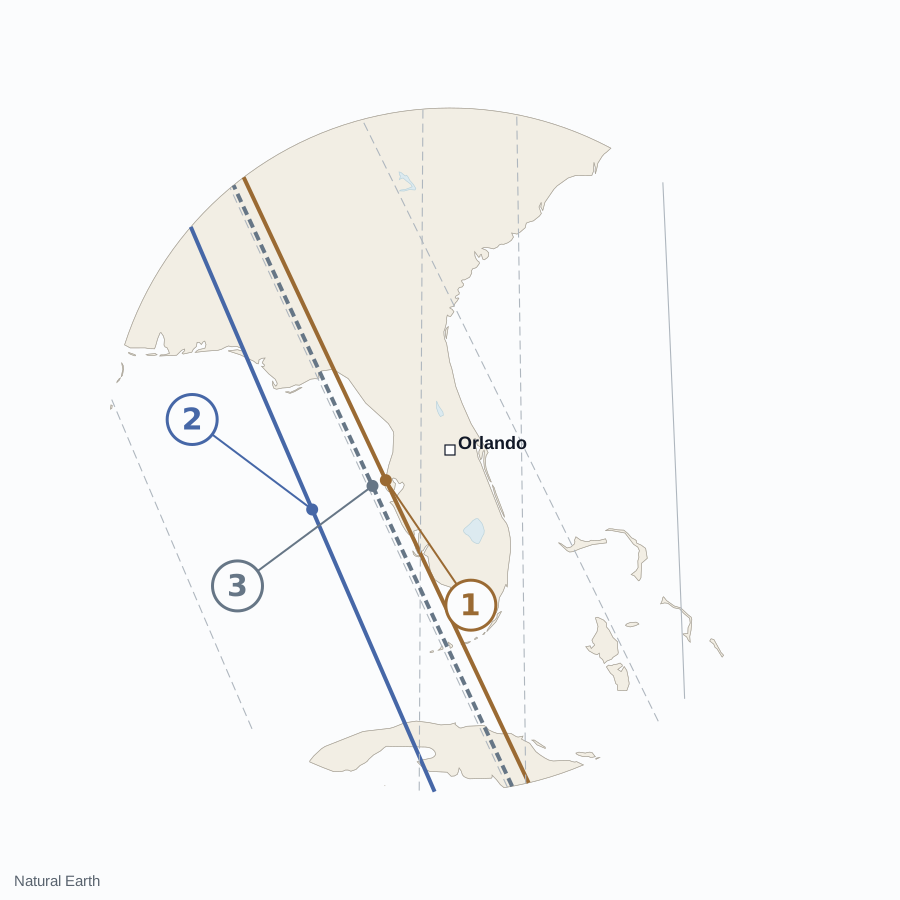
A city can sit near several astrocartography lines with different meanings. In this Orlando sample, a growth theme and a relationship caution coexist. Choosing the closest line alone would hide part of the reading.
Keep the support.
Keep the caution, too.
- Jupiter · ASC≈ 155.5 km
- The sample associates this rising line with exploration and personal growth. It raises a question about how the person could open up in this environment.
- Neptune · DSC≈ 329.2 km
- The sample associates this setting line with idealized expectations and blurred relationship boundaries. A more distant signal can still add a relevant caution.
Read these astrocartography lines as two pieces of evidence, not a verdict on Orlando. Jupiter–ASC supports exploration and personal growth; Neptune–DSC adds a relationship caution. Neither signal, nor its distance, describes every part of living there.
The full sample reading finds the strongest support in home and community, but the greatest caution in relationships. Its home reading also draws on Moon–ASC trine and Venus–ASC sextile evidence, beyond these two lines. For a home, belonging deserves investigation; for settling down together, shared expectations need equal attention. During a trial stay, test everyday routines, privacy and responsibilities.
Find the signals near your own cityDistances are approximate values from this sample report. A click at a slightly different point can produce different distances. Your astrocartography lines depend on your own birth details; Orlando is not a recommendation for everyone.
04 / Bring the meaning back to your life
A better question than
“Is this a good line?”
Ask which of your astrocartography lines matters for the life you would actually live there. Keep one goal in view before comparing places.
Name the life you are considering.
A short creative visit, a demanding career move and a permanent home ask different things of a city. The same astrocartography lines may be relevant to each, but the priorities and acceptable trade-offs change.
Read a place, not just a colored line.
Your map in Astrocartography Chart connects your birth details to the astrocartography lines near a chosen place. Use each planet-angle label and approximate distance to identify the question it raises, then check the surrounding signals. A hidden line still belongs to the calculation; the visible map alone is not the whole reading.
Compare support with the cost of it.
In a city comparison or report available to you, look for support and caution for the same goal, together with the signals behind each judgment. A city may support building a home while relationships need more care. Compare another place on that same question before treating an overall lead as your best choice.
Precision has a limit.
A smaller distance does not make a line “better.” Uncertain birth time can shift astrocartography lines, and extra layers such as angle aspects and astrocartography paran lines need their own interpretation. A Moon–ASC trine in a report, for example, is not an ordinary Moon–IC line simply because its reading mentions home.
Follow the map reading guide to interpret a location, a city comparison and the evidence in a personal report. For a move, explore where to live with astrocartography to find candidates and compare their support for your goals. For IC signals and settling down, explore home line astrology.
Start with the core map. See access and report options to examine a place’s support, cautions and underlying evidence.
Questions that come up
Reading astrocartography lines, thoughtfully.
A label is a starting point. These answers help keep interpretation in proportion.
Which astrocartography lines are best for me?
There is no universally best line. Start with the question you want a place to answer: public work, relationships, home or a short visit. Combine the planet with its angle, then check other signals near the city. A line associated with opportunity can still come with pressure or practical difficulties.
How close do I need to be to a line?
Use distance as context, not a universal boundary where a theme switches on or off. This product shows approximate distances and strength descriptions for nearby signals. Compare them within the same reading method. The nearest of your astrocartography lines is not automatically the most supportive one for your chosen goal.
Can I read astrocartography lines without an exact birth time?
An accurate birth time matters because the angular positions depend on the moment of birth. If you use the unknown-time option, treat the map as provisional rather than a reliable location comparison. Do not turn an estimated time into precise city advice. Check a birth record before drawing narrow conclusions.
What if there are no astrocartography lines near my city?
First check which planets and layers are visible. All planetary lines are free to show or hide. A quiet-looking area means few visible nearby signals in that view, not that the city has no meaning or cannot suit you. Wider context and ordinary considerations such as community, work and cost still matter.
Do crossing lines mean a place is especially lucky?
No. Two drawn astrocartography lines meeting on a map do not establish that their combined meaning is helpful. Read both planet-angle labels and the local evidence. A Paran is a separate relationship involving simultaneous angularity; an apparent visual crossing is not enough to identify or interpret one.
Can I see my astrocartography lines for free?
Yes. All planetary lines, complete map location readings, city checks and standard comparisons are free, without signing in or usage limits. Personal reports, HD downloads, AI features and other advanced tools retain their existing access requirements.